HKM Chennai — Dakshina Dwaraka Dham · Festival & Kārtika Series
Dāmodara-Līlā: The Binding of the Supreme Lord by the Rope of Pure Love
A Kārtika / Dāmodara Month Pastime — adapted from Śrīla Prabhupāda's Kṛṣṇa Book, Chapters 9–10
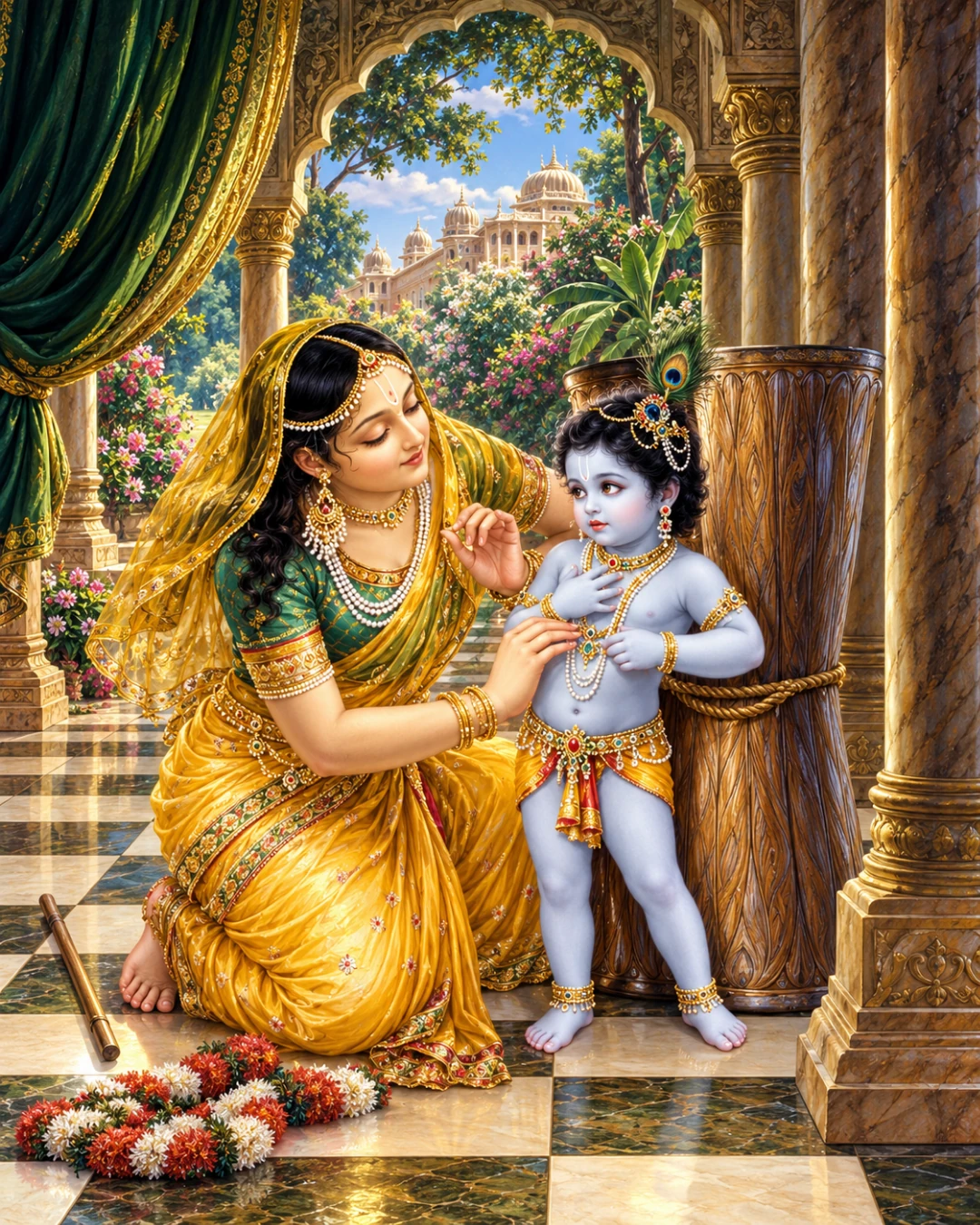 Mother Yaśodā binding baby Krishna with rope – Damodara Lila, Kartik month pastime
Quick Facts: Dāmodara-Līlā & Kārtika Vrata
About This Pastime
Every year, during the sacred month of Kārtika (also called Dāmodara month), devotees throughout the world remember a single, intimate pastime of the Lord: the day mother Yaśodā bound her own son, the Supreme Personality of Godhead, with ropes. Because He accepted this “binding” (dāma) around His belly (udara) out of love, Kṛṣṇa is forever celebrated by the name Dāmodara.
This pastime is narrated by Śrīla Prabhupāda in Kṛṣṇa, the Supreme Personality of Godhead, Chapters 9 and 10 — “Mother Yaśodā Binding Lord Kṛṣṇa” and “Deliverance of Nalakūvara and Maṇigrīva.” The retelling below follows that sequence closely so devotees can read, remember and relish the līlā throughout the month.
The Story of Dāmodara
It began on an ordinary morning in Nanda Mahārāja's courtyard in Gokula, with mother Yaśodā at the churning pot. Her maidservant was busy with other household duties, so she had taken up the churning herself, and as she worked she sang softly of her son's childhood pastimes, lost in thoughts of him. Her sari-end was tied tight for the labor, her bangles tinkled with every pull of the churning rope, and such was her absorption in love for her child that milk flowed from her breasts even as her hands kept moving. Drops of perspiration gathered on her face; the flowers in her hair began to scatter.
It was before this very picture — his mother laboring in love — that the child Kṛṣṇa appeared, hungry, and wanting nothing more than for her to stop churning and let him drink from her breast. Mother Yaśodā lifted him onto her lap at once and let him feed, smiling as she watched his face. But only a moment later, the milk left boiling on the stove began to spill over, and she had to set her son down without warning to rush and save it.
Left alone like this, the child's anger flared. His lips and eyes reddened; he clenched his teeth. Taking up a stone, he broke the very pot in which the yogurt was being churned, scooped out the butter, and carried it off to a secluded corner to eat — shedding tears that, Śrīla Prabhupāda tells us, were not real tears at all, but part of his play.
When Yaśodā returned, she found only the broken pot, her son nowhere in sight. She smiled to herself, certain her clever boy had run off fearing punishment. Searching further, she found him seated upon an overturned wooden grinding mortar, merrily feeding butter — hung from the ceiling out of reach of ordinary children — to a troop of monkeys, glancing this way and that, well aware of his own mischief.
“The Supreme Personality of Godhead who is never approached even by the meditations of great yogīs was being chased by mother Yaśodā.”
— Śrīla Prabhupāda, Kṛṣṇa Book, Chapter 9The moment he saw his mother approaching with a stick in hand, he leapt down and ran. And so began the chase — mother Yaśodā pursuing, as Śrīla Prabhupāda puts it, “the Supreme Personality of Godhead who is never approached even by the meditations of great yogīs”, while her own thin waist and heavy gait slowed her down at every step. Her hair came loose; the flowers from it fell to the ground. Still she pressed on, until at last, tired but determined, she caught her exhausted little boy.
The instant he was caught, something changed. Kṛṣṇa's eyes grew restless with fear, and he rubbed at them with hands still smudged with kohl. Seeing this unnecessary fear in her child's face, mother Yaśodā's heart melted completely. She threw the stick away without a second thought — she had never wished to frighten him, only to correct him — and resolved instead on a gentler punishment: she would simply bind his hands with rope and keep him in one place for a while.
“The child before her had no inside or outside, no beginning or end; he was himself the entire cosmic manifestation, unlimited and all-pervading — and yet, to her, he was only her naughty little boy.”
— Śrīla Prabhupāda, Kṛṣṇa Book, Chapter 9She could not have known, of course, that this was an impossible task. The child before her had no inside or outside, no beginning or end; he was himself the entire cosmic manifestation, unlimited and all-pervading — and yet, to her, he was only her naughty little boy. She brought a rope and began to tie it around him and the mortar, but found it two inches too short. She fetched more rope and added it on, and still, somehow, it fell exactly two inches short. Again and again she gathered every piece of rope in the house and joined them together, and every single time, by the same impossible two inches, the final knot would not meet.
Mother Yaśodā smiled in bewilderment at what was happening, growing more tired and perspiring with every attempt, the garland on her head slipping loose. And it was then — watching her labor so simply and so sincerely, for no reason but love — that the Lord relented. Not because he could be forced, never that, but because he wished to reciprocate the devotion of his devotee, Kṛṣṇa allowed the rope to finally close around him. From this one act of submission to love, he has been known ever since by a new name: Dāmodara, the Lord who let himself be bound by the rope (dāma) around his belly (udara).
The Deliverance of Nalakūvara and Maṇigrīva
Bound now to the heavy wooden mortar, the child's eyes fell upon a pair of tall arjuna trees standing just outside. These were no ordinary trees. In a previous life they had been Nalakūvara and Maṇigrīva, two proud young demigod sons of the treasurer Kuvera, who had grown so intoxicated by wealth and wine that one day, deep in drink, they had revelled unclothed with young women in the waters of the Mandākinī Ganges — so lost in their pleasure that they failed even to notice the sage Nārada passing by. Nārada, seeing their degraded state, was moved not to anger but to compassion. Out of mercy, he cursed them to become motionless trees, so that one day, through this very curse, they might stand before the Lord himself and be delivered.
Still bound, still dragging the mortar behind him, the child began to crawl toward those two trees, remembering the words of his great devotee Nārada and resolving to fulfill them. He passed easily between the trunks, but the broad mortar caught crosswise and lodged there. Taking hold of the rope with full strength, he pulled — and the two great trees, with all their branches, came crashing down with a sound that shook the whole courtyard.
From the wreckage of the fallen trees stepped two radiant beings, glowing like living flame, lighting up all directions with their presence. Nalakūvara and Maṇigrīva bowed before the child at once and offered him prayer after prayer — glorifying him as the original Personality of Godhead, the Supersoul seated within every heart, the source from which the entire cosmic manifestation unfolds, untouched by the modes of nature even while pervading them, the one Lord who appears in this world through his own causeless mercy.
Kṛṣṇa, smiling, still bound to the mortar by his mother's ropes, told them gently that he already knew everything — that Nārada's curse had always been a disguised blessing, rescuing them from a far worse fate of pride and downfall. To behold a pure devotee like Nārada face to face, he said, is liberation in itself. This, he told them, was their final birth in the material world; they could now return to their father's abode, fixed forever in loving service to him. The two brothers circled the Lord many times in reverence, bowed again, and departed — while the Lord himself remained exactly as he had chosen to be: a small child, happily bound by the ropes of his mother's love.
The Essence of the Pastime
Śrīla Prabhupāda explains that this līlā shows the unique exchange of rasa between the Lord and His devotee: the Lord who cannot be bound by anyone in the universe surrenders, out of love, to the ropes of a devotee. Both are glorified by the exchange — the devotee for her pure affection, and the Lord for His reciprocation. This is the mood devotees try to enter during the month of Dāmodara.
ahaḿ bhakta-parādhīno hy asvatantra iva dvija
sādhubhir grasta-hṛdayo bhaktair bhakta-jana-priyaḥ
“I am completely under the control of My devotees. Indeed, I am not at all independent. Because My devotees are completely devoid of material desires, I sit only within the cores of their hearts.”
— Śrī Caitanya-caritāmṛta, Madhya 19.167
How to Observe Dāmodara Vrata
The month of Kārtika (Dāmodara month) is considered exceptionally dear to the Lord — scripture states that even small acts of devotion performed in this month bring disproportionate results. Below is a simple, authentic way to observe it, drawn from Vaiṣṇava tradition as followed in ISKCON temples worldwide.
A Simple Daily Routine
Rise & Bathe
Rise early (ideally during brahma-muhūrta) and bathe before beginning the day's devotional activities.
Chant Attentively
Chant the Hare Kṛṣṇa mahā-mantra attentively, fixing a regular daily round of japa meditation.
Read Krishna Book
Read or hear Śrīla Prabhupāda's narration of the Dāmodara-līlā — Kṛṣṇa Book, Chapters 9 and 10 — at some point during the day, even a few minutes of sincere hearing.
Honor Prasādam
Cook and offer vegetarian foodstuffs to the Deity or picture of Kṛṣṇa, and honor only sanctified prasādam throughout the month.
Gather Loved Ones
In the evening, perform the ghee-lamp offering. Where possible, gather family, friends or neighbors to join the evening ārati and let each person also have the blessing of offering a lamp to Lord Dāmodara.
Offering the Ghee Lamp (Dāmodara Dīpa-dāna)
The central practice of this month is the daily offering of a small ghee lamp to Lord Dāmodara, usually in the evening at dusk, accompanied by the singing of the Śrī Dāmodarāṣṭaka prayers composed by the great sage Satyavrata Muni.
🪔 Procedure for Evening Dīpa-dāna
- Use a clean diya: Prepare a clay or brass diya with pure cow's ghee and a cotton wick. (Sesame oil may be used if ghee is not available).
- Place the picture: Light the lamp before the Deity, or a picture of mother Yaśodā binding Lord Dāmodara, if no Deity is present at home.
- Sing Śrī Dāmodarāṣṭaka: While the lamp burns, sing the eight verses of Śrī Dāmodarāṣṭaka, meditating on its deep meaning — the verses describe Kṛṣṇa's tearful eyes as He is bound, and pray for unflinching devotion at His lotus feet.
- Offer the lamp: Offer the lamp with gentle circular ārati movements (circling it clockwise four to seven times before the Deity), then pass the tray so others present also have the opportunity to offer.
- Offer a sincere prayer: Conclude with a heartfelt prayer asking to be engaged, like Nalakūvara and Maṇigrīva, in the Lord's loving devotional service birth after birth.
“Even if there are no mantras, no pious deeds, and no purity, everything becomes completely perfect when one offers a ghee lamp during the month of Kārtika.”
— Padma Purāṇa, Uttara-khaṇḍa
The Padma Purāṇa states that one who offers a ghee lamp to Lord Dāmodara during Kārtika is freed from accumulated sinful reactions and attains the abode of the Lord. The lamp is offered as pure love and gratitude, not as a commercial transaction — those unable to arrange a physical diya can still participate fully through sincere chanting, hearing and devotional service.
Frequently Asked Questions
Essential answers on Dāmodara-līlā, Kārtika vows, and ghee lamp offerings for devotees and seekers.
Scriptural Citations & Sources
This article is faithfully adapted from the canonical Gaudiya Vaishnava scriptures and Śrīla Prabhupāda's authoritative commentaries:
- Śrīla Prabhupāda's Kṛṣṇa Book, Chapter 9: 'Mother Yaśodā Binding Lord Kṛṣṇa' ↗
- Śrīla Prabhupāda's Kṛṣṇa Book, Chapter 10: 'Deliverance of Nalakūvara and Maṇigrīva' ↗
- Śrīmad-Bhāgavatam, Canto 10, Chapters 9 & 10 — The childhood pastimes of Lord Śrī Kṛṣṇa in Gokula ↗
- Śrī Dāmodarāṣṭaka by Satyavrata Muni (from the Hari-bhakti-vilāsa) — sung daily across Gaudiya Vaishnava temples during Kārtika ↗
- Padma Purāṇa (Kārtika-māhātmya) — statements on the unprecedented spiritual merit of Dāmodara Dīpa-dāna ↗
Celebrate Kārtika with Us at ISKCON Chennai
Experience the enchanting evening Dāmodara Dīpa-dāna and soul-stirring kirtanas at Srila Prabhupada's ISKCON Thiruvanmiyur — Dakshina Dwaraka Dham. Every evening of Kārtika month, hundreds of devotees gather to offer ghee lamps and sing the Śrī Dāmodarāṣṭaka.
Hare Krishna Hare Krishna, Krishna Krishna Hare Hare | Hare Rama Hare Rama, Rama Rama Hare Hare
Explore Related Festival Articles
Bahuda Yatra & Suna Besha →
Lord Jagannath's journey home and grand golden return at Puri.
FestivalPanihati Chida Dadhi Mahotsava →
The blissful festival of chipped rice and Lord Nityananda's mercy.
FestivalSri Ramanavami Celebrations →
The appearance and divine pastimes of Maryada Purushottama Lord Ramachandra.
Connect with Us
Follow Hare Krsna Movement Chennai across all platforms for daily darsana and event updates.
Srila Prabhupada's ISKCON Thiruvanmiyur | Dakshina Dwaraka Dham, Chennai